 Yogurt Atelier
The Long Story of Yogurt
How a happy accident in warm milk became one of the world's oldest foods.
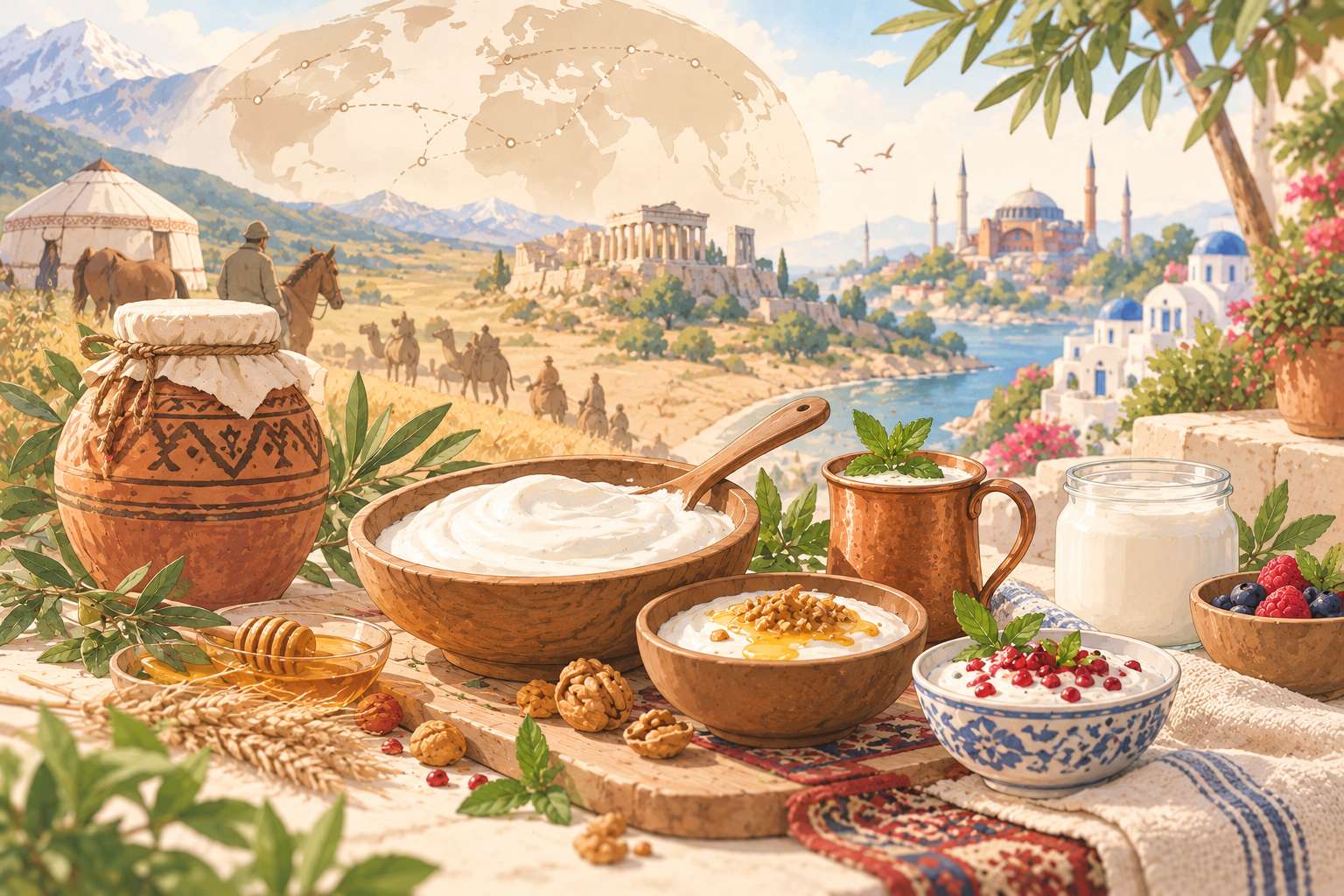
Nobody can say who made the first yogurt, or where. Food historians agree the idea is very old, and that it probably began as an accident: fresh milk, carried and stored in a warm place, quietly turned thick and tangy. What we do have are clues, from language, from cooking traditions and from what archaeologists can and cannot tell us. This article follows those clues and is careful about which ones are solid.
A food older than its name
Dairying is ancient. Evidence of people processing milk in places such as Anatolia and Mesopotamia reaches back thousands of years. But archaeology struggles with a fine point: it can show that milk was being handled and turned into something durable, yet it cannot easily show whether that something was yogurt, a sour milk drink or a fresh cheese. Any story that names a single inventor, a single valley or a single date is telling you more than the evidence allows.
Milk that kept
For herding communities, soured milk was a gift. Fresh milk spoils quickly in the heat, but milk that has been fermented by friendly bacteria keeps its quality for longer, carries more easily and tastes pleasantly sharp. People did not need to understand microbes to benefit from them. They only needed to notice that a warm pot, a little of yesterday's milk and some patience gave a reliable result. Different regions settled on different versions, using whichever milk and whatever warmth they had.
Fermentation turned a perishable food into a pantry staple long before refrigeration.
A name from Turkish
The English word "yogurt" comes from Turkish. Its first recorded use in English dates to 1625, when a travel account compiled by Samuel Purchas spelled it "Yoghurd" and noted that the Turks did not drink much milk unless it had soured. Where the Turkish word itself comes from is less settled. The most common explanation links it to the verb yoğurmak, "to knead" or "to thicken", which fits what happens to milk as it cultures. Specialists still debate that derivation, and other readings have been proposed. It is worth remembering that the history of a word and the history of a food are separate questions: the name tells us where English found the word, not where the food began.
A spoonful passed along
For most of history, yogurt was a home and village food. A household kept its culture alive by saving a spoonful from each batch to start the next, which is why families, villages and regions developed yogurts with their own flavors and textures. The method was passed from person to person rather than written down, and it needed no special equipment beyond a clean vessel and a warm corner of the kitchen.
From village to supermarket
Over the twentieth century yogurt moved from household kitchens into factories and shops, and eventually into every supermarket. Industrial production brought consistency, and with it a need to say what counts as yogurt. International food standards now describe it by its cultures: the Codex Alimentarius standard for fermented milks defines yogurt as milk fermented by a partnership of Streptococcus thermophilus and Lactobacillus delbrueckii subsp. bulgaricus, and expects those cultures to be alive and abundant in the product until its date of minimum durability. National rules vary, and some products that look like yogurt are made with other cultures or treated after fermentation, a point we return to in the article on reading labels.
What stayed the same
Strip away the packaging and modern yogurt is still the same simple idea: warm milk, a starter and time. That continuity is part of its charm. When you save a spoonful from a good batch to begin the next one, you are doing something people have done for a very long time, even if nobody can say exactly when it started.
Warm milk, a starter and patience: the method has barely changed.
Bring your curiosity
into the kitchen.
Explore guided preparation, fermentation tracking and yogurt recipes in Yogurt Atelier for iPhone.
 Coming soon to the App Store.